Two treatments can deliver the same total dose and produce very different results. That's the core lesson from a recent histotripsy write-up, and it maps neatly onto your kitchen. By the end, you'll see why timing, not just total effort, decides whether something tough breaks down, and how to apply that thinking to the fibrous cuts you cook.
A quick caveat first: this is a medical ultrasound story, not a food study. Nothing in it tests meat, recipes, or diets. The kitchen comparisons below are my own analogies, clearly separate from the research.
What the research found
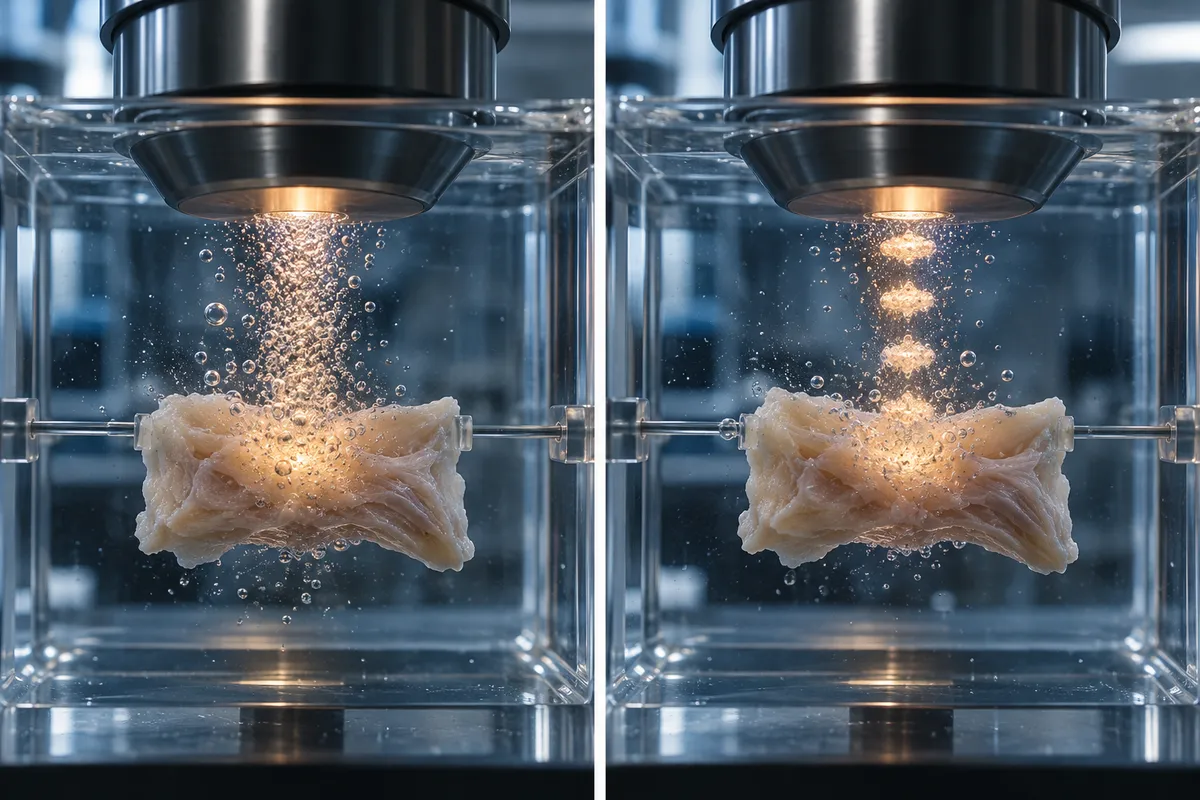
Per Medicalxpress, a researcher reflecting on their Ph.D. work asked a deceptively simple question: why are some tissues so much harder to break down with histotripsy than others? Histotripsy is a focused ultrasound approach that works through non-thermal, mechanical action involving cavitation bubbles, rather than by heating.
The key finding: outcomes varied dramatically even when treatments used the same 1% duty cycle. Longer pulses delivered at lower repetition frequencies produced more complete liquefaction in tough, fibrous materials than short, rapid pulses did.
In other words, the same total exposure, packaged differently, gave very different results.
Why "same dose" isn't "same effect"
Duty cycle is simply the fraction of time the ultrasound is on. At 1%, it's on for a sliver of the total time. You can reach that 1% many ways: lots of tiny pulses fired quickly, or fewer long pulses spaced further apart.
The study's takeaway is that pulse timing, not just total exposure, could be critical. Duty cycle alone doesn't predict what happens in tough, fibrous material.
This matters medically. Per the report, histotripsy is being explored for tougher, more fibrous tissues, such as those involved in benign prostatic hyperplasia (BPH), where treatment predictability is a major challenge.
The kitchen analogy (my take, not the study's)
Cooks already know a version of this. Fibrous, connective-tissue-heavy cuts like brisket, shank, or chuck don't care only about total heat. They care about how that heat is delivered.
- Blasting at high heat for a short time tends to leave tough cuts chewy.
- Gentler, longer cooking gives connective tissue time to soften.
That's an analogy, not a claim that ultrasound and braising work the same way. Histotripsy is mechanical, not thermal. But the shared principle is useful: for tough structures, a bigger single push at a slower rhythm can beat many quick taps.
Practical ways to use the idea
For anyone building paleo-friendly meal plans around budget cuts of meat, here's how to apply the "timing beats total" mindset:
- Pick fibrous cuts on purpose. They're typically cheaper and reward patience.
- Give them one long, low cook rather than repeated short bursts of high heat.
- Rest and check texture, not the clock. Total minutes are a guide; how the fibers yield is the real answer.
- Batch cook. A long braise on a weekend can feed several meals, with leftovers for easy protein-forward snacks and lunches.
What the study does and doesn't tell us
The findings concern tough fibrous materials and histotripsy pulse design. They don't say anything about nutrition, digestibility, or how food behaves. The medical significance is that better pulse design could make noninvasive ultrasound therapies more predictable for stubborn tissues.
The food lesson is a thinking tool, nothing more: when something resists, ask how the effort is delivered before you add more of it.
Takeaway
Next time a tough cut fights back, don't just add time or heat. Change the rhythm: go lower, go longer, and let the fibers give way.