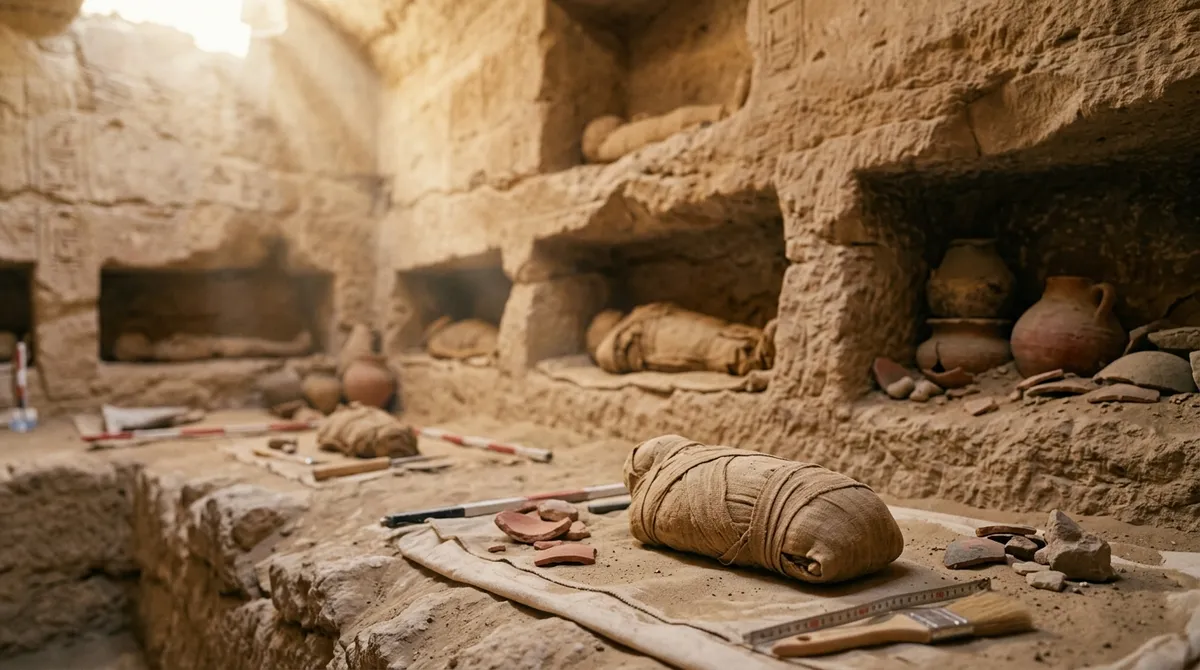
The recent discovery of at least 20 mummified individuals and a dog in Theban Tomb 209, located near Luxor, deeply reshapes our understanding of ancient Egyptian burial practices. This find showcases a continuity of care and rituality over a 300-year span, contradicting the traditional narrative of chaotic burial practices in crowded tombs.
A Quick Overview of Theban Tomb 209
Excavations in chamber three of tomb TT 209 have opened a window into the complexities of ancient Egyptian funerary rites. Histories reveal that this tomb was initially constructed during the 25th Dynasty (754–656 BCE), a period marked by the Nubian or Kushite Empire. Archaeologists from Spain’s University of La Laguna conducted the research, which was published in the journal Frontiers in Environmental Archaeology. Their meticulous documentation included the positioning of each mummy, showcasing how space within the chamber evolved over generations.
Rethinking Mummy Arrangements
Traditionally, we visualize ancient Egyptian mummies encased in ornately designed sarcophagi, often arms crossed in a gesture of repose. However, the findings at TT 209 tell a different story. As the years progressed, mummies were sometimes arranged vertically, something that might seem chaotic at first glance. Yet, researchers argue there was a deliberate logic behind these practices.
Jared Carballo-Pérez, a co-author of the study, stated that the placement of bodies revealed a careful consideration in retaining a kind of 'funerary memory.' This reflects a respect for those who were buried there, rather than an increasing disregard or random accumulation over time.
The Emotional Connection to Burial Practices
Interestingly, the study highlights the emotional aspects behind these burial choices. For instance, the presence of a mummified dog placed atop two human bodies suggests deep emotional relationships in life. As Carballo-Pérez remarked, this arrangement invites us to empathize with the connections between humans and their pets, emphasizing the humanity within these ancient practices.
It is crucial to recognize that the earliest burials in TT 209 involved individuals of high status, adorned with costly items, coffins, and amulets. In contrast, by the time of the Persian period (680–404 BCE), this practice shifted to accommodate the available space, indicating a complex, evolving relationship with death that maintained rituals and respect.
How This Changes Our Understanding of Ancient Egyptian Funerary Practices
This evolving burial strategy contradicts previous theories about ancient Egyptian tombs being filled in a disorderly manner as a sign of neglect. Instead, the findings from this tomb highlight a meticulously planned process that adapted to historical contexts while maintaining reverence for the deceased. Each new deposit was adapted to the presence of earlier burials, showcasing an elaborate framework for remembering and honoring the past.
These insights prompt us to reconsider how we view ancient Egyptian mummies and their burial sites. Instead of seeing chaotic tombs filled randomly over time, we can appreciate them as places of continuity, memory, and the layering of rituals that connect the living with their ancestors.
Conclusion: A Legacy of Continuing Rituals
The discovery from Theban Tomb 209 serves as a remarkable reminder that ancient Egyptians were not simply relegating their dead to oblivion but were instead forging connections across generations. As you reflect on this research, consider how it helps us understand not only the practices of ancient cultures but also our own relationship with memory and loss. Each burial tells a story of resilience, adaptation, and respect, proving that even in ancient times, the bonds between individuals—be they human or animal—carried profound significance.